Pausa started during a long weekend in late 2024. I had been working on Camins for about four months, deep in puzzle system design — trying to figure out the right relationship between path tracing and discovery pacing — when I needed to do something completely different for a few days. Something with no moving parts, no mechanics to balance, no design problems to solve. Something that was just about being still.
That was the seed. Not a design document. Not a pitch. Just: what would a game look like if staying still was the win condition?
The Constraint That Became the Game
I gave myself a rule: no fail states. Pausa would have no lose conditions, no wrong answers, no timers, no score. Whatever the player did — or did not do — would be accepted. The game would respond to presence, not performance.
This turned out to be a more radical design constraint than I expected. Most of the interactive design patterns we reach for as game developers exist to manage the tension between player intention and game response. You press a button, something happens, you evaluate whether the outcome was good or bad, you adjust. When you remove outcomes from that loop, the traditional game-design toolkit mostly stops being useful. You are not designing a challenge. You are designing a space.
Designing a space is closer to sound design or interior architecture than to game design in the conventional sense. The questions shifted: what does presence in this space feel like? What is the sensory texture? How does the space change with time, without player input, in ways that feel alive rather than mechanical?
The Breathing Mechanic Came Last
There is a version of Pausa's story that says the breathing mechanic was the original idea, the thing that unlocked everything else. That would make a cleaner narrative. It is not what happened.
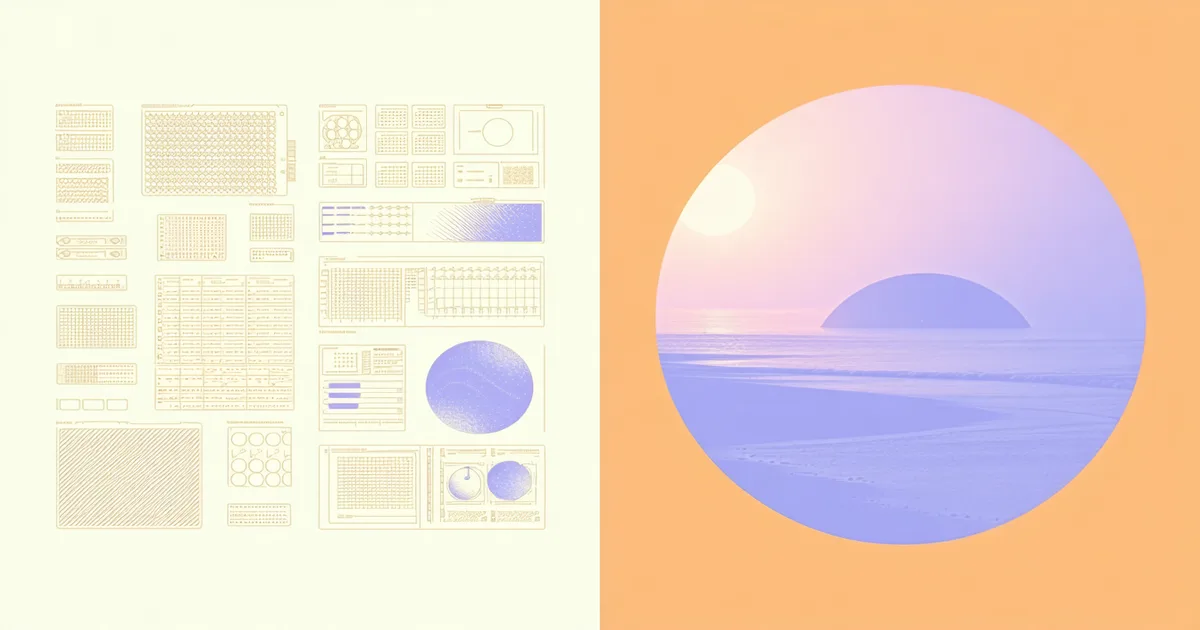
For the first three weeks, Pausa had no interaction at all. It was a visual and audio environment that ran on its own — slow particle animations, a procedural audio layer, soft color gradients cycling through the blues and lavenders of the game's eventual palette. I was happy with it as an experience but uncertain whether it was a game in any meaningful sense. Something was missing — not a challenge, but a point of contact. A place where the player could leave a mark.
The breathing mechanic — holding a key or button to expand the visual field, releasing to let it settle — emerged from that gap. It gave players something to do that was not evaluated, not scored, just felt. The interaction was tuned carefully: the expansion and contraction curves were iterated over probably twenty sessions, dialing in the timing so that the game's response matched a slow, natural breathing rhythm rather than an arbitrary animation. We wanted players to find themselves breathing with it, not performing for it.
When that felt right, the game clicked into place. Everything else — the sound design, the visual palette, the minimal UI — was refinement.
Accessibility First, Not Accessibility Later
Because Pausa had been conceived partly as a rest from the complexity of Camins, its accessibility footprint was more limited by design. But the features it does have were treated with the same rigor we apply to the larger games.
Colorblind support in Pausa is handled through three color filter modes — Protanopia, Deuteranopia, and Tritanopia — that shift the game's soft color palette to ensure the visual gradients remain distinct and meaningful across different types of color vision. Because the game communicates primarily through color temperature and saturation rather than specific hue (the "breathe in" phase is not coded as "the blue phase" — it is coded as "the lighter phase"), the filters adjust the whole palette rather than just swapping specific values. This took longer to implement than we expected because the aesthetic target was a palette that felt equally beautiful in all three modes, not just technically distinct.
Reduced motion mode was non-negotiable. A game built around visual breathing animation needed to work for players with vestibular conditions or motion sensitivity. In reduced motion mode, the particle animations and color cycling slow to roughly a quarter of their default speed, and the breathing mechanic's expansion effect becomes more subtle — still present, still interactive, but no longer a dominant visual movement.
The full keyboard and gamepad support was straightforward to implement given the simplicity of the interaction model: one action, mapped to any key or button the player chooses.
Shipping on itch.io: What We Learned
Pausa went live on our itch.io page about eight weeks after that first weekend. The production time was short not because we cut corners but because the game's scope was genuinely small — a deliberate choice to finish something rather than expand it into something we could not finish.
The itch.io page itself took longer to write than I expected. Our initial description was too mechanical: it explained what the interaction was without conveying what the game felt like. We rewrote it three times. The final version — "A game about breathing. Really." — took about four hours to arrive at and is, I think, the piece of writing in our entire studio portfolio I am most satisfied with. It does the job with six words.
The pay-what-you-want pricing model was a deliberate choice. Pausa is a short game — most sessions run between five and twenty minutes. Charging a fixed price felt like setting a wrong expectation about what kind of game this is. The PWYW model lets players decide what the experience is worth to them, which is consistent with the game's own philosophy: presence without evaluation.
We were genuinely surprised by how many players left notes about using Pausa during specific stressful moments — before medical appointments, during anxiety episodes, late at night when sleep would not come. These were not use cases we had explicitly designed for, but they were consistent with the constraint I had started with. The game accepted what players brought to it.
What Pausa Changed About How We Work
The most lasting effect of building Pausa was not the game itself but what it demonstrated about creative constraint. The rule — no fail states — was not a limitation on what the game could be. It was the thing that made the game what it is.
We now build deliberate constraints into the early design of every project. Not as a substitute for design thinking, but as a starting condition that shapes the design space before we get attached to patterns we would otherwise reach for by habit. For Camins, the core constraint was: no punishment for curiosity. For the next project we are quietly planning, the constraint is still forming. But we know it will be specific, and we know it will be structural.
The other thing Pausa changed was our relationship to scope. Eight weeks to a shipped game, for a small studio with other work in progress, is a meaningful demonstration that finishing is possible without a large team or a long runway. We think about this when Camins development gets complicated, when problems compound and the list of things to fix is longer than the list of things that are working. The fact that Pausa exists and is complete is not a small thing.